

Unfortunately, vision problems and eye diseases in children often go undetected for a long time, as the child itself considers the way it sees to be completely normal and assumes that this is the case for everyone, and therefore does not even notice that he or she may be suffering from visual impairment. Children may experience some of the same eye problems found in adults; however, their care is often quite different.
This can have an impact on your child’s learning behavior, everyday life, and ultimately their development. Early diagnosis and comprehensive evaluation of a child’s vision and condition are crucial, especially for infants who may not be able to communicate symptoms. That’s why it’s important to identify eye problems in children as early as possible, particularly for families adapting to their expat life in the US, where navigating the healthcare system may initially feel unfamiliar.
In this article, you will learn when it is advisable to take your child to an ophthalmologist, the different types of specialized ophthalmologists in the US, what you as a parent should look for when choosing an eye-doctor for your child, the role of health insurance in the US, and when private international health insurance may be a good idea to avoid paying out of pocket.
Children may be too young to explain their symptoms or to sit patiently for exams, which makes specialized pediatric eye care essential.
When should you take your child to an eye specialist?
As mentioned above, your child will most likely not complain about problems with their vision, so it is important to watch for typical warning signs and symptoms, especially in very young children. These symptoms include frequent blinking or squinting, headaches when reading, sitting very close to the screen or book, and rubbing their eyes quite often.
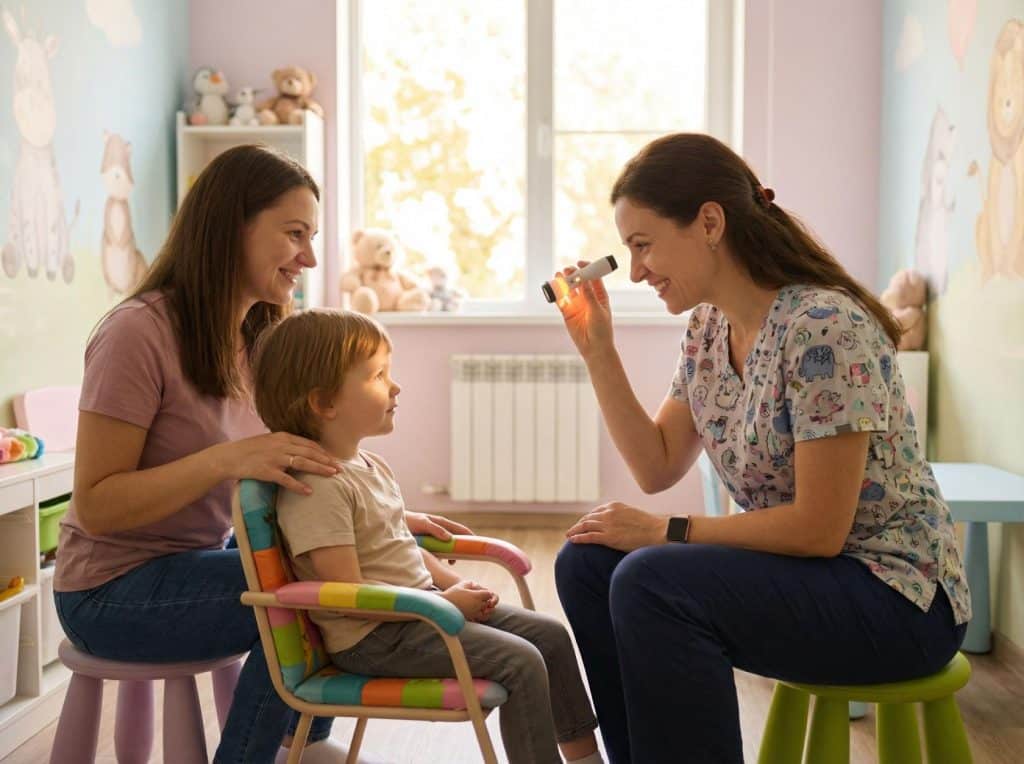
Both the American Academy of Ophthalmology and the American Optometric Association therefore recommend the first examination at around six months, the second examination at around three years, another examination at the age of 5-6, before starting school, and then a routine examination every two years as long as no vision problems are apparent.
What types of eye doctors are there for children in the US?
To avoid choosing the wrong eye doctor and having to make multiple appointments, it helps to have a brief overview of the different types of eye doctors available for children in the US.
Optometrists
Optometrists are often the first point of contact for any vision problems. An optometrist is a highly qualified specialist who can perform comprehensive eye health checks, identify abnormalities, and perform precise vision tests. They often work closely with an optician and make recommendations for vision aids and eyeglasses.
Ophthalmologists (eye doctors)
Although the terms optometrist and ophthalmologist are often used synonymously, they are two different professions. An ophthalmologist is a medical specialist in eye diseases. He or she can do everything that an optometrist does, but they can also treat complex eye diseases and even perform eye surgery if necessary.
Pediatric ophthalmologists
The best place to go, especially for young children, is definitely a pediatric ophthalmologist, as they specialize in eye problems in children and are familiar with early childhood vision development. They are best able to diagnose and treat eye diseases specific to children.
Pediatric ophthalmologists manage a wide range of conditions, from common vision issues to more complex disorders. They frequently treat problems such as strabismus (eye misalignment), nystagmus (involuntary eye movements), and diseases affecting the retina or optic nerve. They also monitor how a child’s vision develops over time and recommend appropriate treatments when necessary.
Care is often delivered through a coordinated pediatric eye care approach, ensuring children receive comprehensive evaluation and follow-up.
Another advantage is that pediatric ophthalmology clinics are designed with children in mind. They usually offer a kid-friendly environment, specialized equipment adapted for young patients, and staff trained to communicate with children in a calm and reassuring way.
And what are common vision problems in children?
Myopia, or nearsightedness, is one of the most common vision problems in children. This causes objects that are further away to appear blurred. However, hyperopia (farsightedness) can also occur in children and makes reading or concentrating on tasks difficult in everyday life, as these activities can prove to be particularly strenuous. Distorted or blurred vision can be caused by astigmatism, an irregularity of the cornea.

In addition, certain developmental disorders of the eyes can occur, especially in younger children. These include, for example, amblyopia, in which one eye does not develop normally, or permanent strabism. Early detection is particularly helpful in preventing long-term vision problems, as it significantly increases the success of treatment.
Eye injuries and emergencies
Eye injuries can be particularly distressing for both children and parents, but knowing how to react can make a real difference. If your child experiences severe eye trauma, sudden vision loss, or intense eye pain, it is important to stay calm and seek immediate medical care from a pediatric ophthalmologist.
Pediatric ophthalmology teams are trained to manage many types of emergencies, including chemical burns, foreign objects in the eye, or infections such as pink eye. In more serious situations, board-certified ophthalmologists may need to perform surgery to repair damage and prevent long-term vision problems.
Parents should also watch for early signs of vision issues, such as amblyopia (lazy eye), strabismus (crossed eyes), or a blocked tear duct. If any symptoms appear, consulting a pediatric eye specialist promptly is recommended.
Finally, regular vision tests and routine eye exams play an essential role in detecting problems early and helping children maintain healthy vision as they grow.
How can parents in the US find the right eye doctor for their child?
A quick search on relevant websites can provide an overview of pediatric ophthalmologists in the area.
Official websites include, for example, the American Association for Pediatric Ophthalmology. This is an official directory for finding pediatric ophthalmologists (eye doctors for children) in the US. Parents can filter by city, state, or zip code.
The AOA search tool also helps find optometrists (eye exams/general care) nearby, including child-friendly options.
And then there’s the tried-and-true MedlinePlus Doctor and the Ophthalmologist Directories. These are official medical directories where you can search specifically for ophthalmologists.
However, we would still like to give you a few practical tips that go beyond a generic internet search.
When choosing your child’s eye doctor, pay attention to the following points:
The eye doctor has experience with children:
- He or she specializes in pediatric ophthalmology
- He or she has experience with childhood vision problems
He or she runs a child-friendly practice:
- The practice has a calm, child-friendly atmosphere
- Not only the doctor himself or herself, but also the staff has experience in dealing with young patients
It also helps to ask around among friends and acquaintances, as other parents often have good recommendations for pediatric ophthalmologists in the US. Of course, you can also ask your pediatrician who they would recommend, or inquire at your child’s daycare or school.
Does American health insurance cover eye exams for children?
Whether the costs of an eye exam or treatment for children in the US are covered depends largely on the type of health insurance. Without health insurance, care can quickly become expensive. This is something many families notice when considering the cost of living in USA, where medical expenses often represent a significant part of the overall budget.
Vision insurance usually covers routine eye exams, glasses, and contact lenses, while traditional health insurance typically covers medically necessary exams or treatments for eye diseases. Most children also receive basic medical care through government programs such as Medicaid, which may include eye exams under certain conditions.
Although routine eye tests play an important role in the early detection of vision problems, they are not always fully covered by insurance. Medically necessary treatments or referrals to specialists, such as an ophthalmologist, are generally covered, although the co-payment may vary depending on the insurance plan.
For families, and especially for expats or parents who travel a lot, it is often worthwhile to take out a private international health insurance in the US as that offered by Global Health, as certain policies cover both routine and medically necessary eye examinations for children. This
offers you and your family additional security, as ophthalmological treatment for children in the US can otherwise quickly become expensive.
Related posts

How to choose a doctor in the United Arab Emirates: moving to Dubai or Abu Dhabi with your family
Have you just moved to the United Arab Emirates, or is your move abroad getting closer? After finding a place…

Is the beer belly really a result of drinking beer?
The beer belly is a familiar image and has become deeply embedded in popular culture. A rounded abdomen is often…